Is a loan payment an expense? What to record instead
You make a loan payment, the money leaves your bank account, and suddenly your expenses look much higher than usual.
That can make a perfectly ordinary month look like you spent far more running the business than you actually did. It may also leave you wondering why your profit looks lower, why your equipment costs look odd, or why the numbers don't match what you expected.
A loan payment is one of those bookkeeping details that seems harmless until it muddies the reports you use to make decisions. This post will show you how loan payments should be recorded, why the split between principal and interest matters, and what can go sideways when the full payment lands in expenses.
Is a loan payment an expense?
A loan payment is partly an expense and partly a reduction in what you owe. The interest portion is generally recorded as an expense, while the principal portion reduces the loan balance on your balance sheet.
For example, if you pay $1,000 toward a business loan and $150 is interest, your profit and loss statement should show $150 in interest expense. The remaining $850 reduces the loan balance on your balance sheet. The money has left your account, but the $850 doesn't belong in that month’s operating costs.
Why the full loan payment can distort your reports
Your bank feed only knows that $1,000 left your account. It has no idea how much of that payment was interest, how much paid down the loan, or whether the loan was used for a vehicle, equipment, renovations, or working capital.
If the entire payment gets categorized as an expense, your profit and loss statement tells a strange story.
It can make it look like:
→ Your operating costs jumped for no obvious reason.
→ Your profit dropped sharply in a month where the business itself performed normally.
→ Your margins are thinner than they actually are.
→ A piece of equipment is costing you more each month than it really is.
→ Your business can't support a hire, owner draw, or planned purchase when the reports are simply misclassified.
That’s more than a small bookkeeping technicality. Those reports often sit behind decisions about spending, pricing, staffing, and how much cash you can safely take from the business.
A report that includes the full loan payment as an expense can make a healthy month look a bit grim for reasons that have nothing to do with sales or actual operating costs. You don't need that kind of false alarm.
What happens when you borrow money for the business?
A business loan creates two things in your books:
The business receives cash.
The business takes on a liability, meaning an amount it owes back.
Say you borrow $40,000 to buy a piece of equipment.
When the funds arrive, the $40,000 is generally recorded as an increase to your bank account and an increase to your loan payable account.
The borrowed money doesn't count as revenue. You have more cash available, but you also have a debt to repay.
Then, when you use that money to buy equipment, the equipment itself is usually recorded as an asset. Depending on the purchase and your tax situation, it may be depreciated over time rather than treated as one large expense in the month you bought it. Your accountant can advise on the tax treatment that applies to your business.
Want to learn more about the difference between profit, cash, and bank balance? Check out this post, here.
The same principle carries through to the monthly loan payments. The payment is connected to the debt, and only the interest portion generally appears as an operating cost.

How should you split a loan payment?
A proper loan payment entry separates principal from interest.
Let’s use a simple example.
Your monthly loan payment is $1,200. The lender statement shows that $950 went toward principal and $250 went toward interest.
Your bookkeeping entry should reflect both pieces:
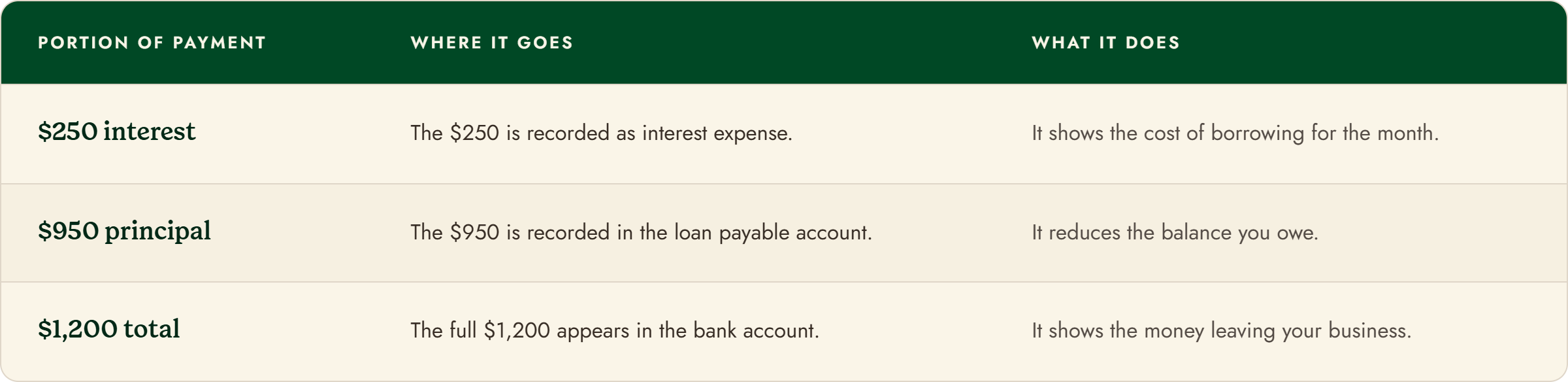
Your profit and loss statement should show the $250 interest expense.
Your balance sheet should show that the loan balance has dropped by $950.
Your bank account will, of course, show the full $1,200 leaving. All three reports can be correct at the same time because they answer different questions.
This is also why a bank balance alone can't tell you whether the business was profitable that month. The bank account records cash movement. Your financial reports help explain what that movement was for.
Where can you find the principal and interest amounts?
Your lender should provide an amortization schedule, loan statement, or payment breakdown showing how each payment is split.
For many loans, the interest and principal amounts change over time. Earlier payments may include more interest, while later payments put more toward principal. Recording the same split every month without checking can gradually throw off the loan balance.
If you can't find the schedule, ask the lender for one. You need enough detail to record the payment properly and to make sure the loan balance in your books agrees with what the lender says you owe.
For vehicle financing, equipment loans, lines of credit, and business loans, the documentation may look a little different. The bookkeeping principle remains the same: identify the interest, record the principal against the liability, and make sure the balance is reconciled.
Why does the loan balance need regular attention?
It’s easy to focus on the profit and loss statement because that's where revenue and expenses live. But a loan is also a balance sheet item, and leaving it unchecked can create a problem that waits politely in the background until year-end.
If payments are recorded entirely as expenses, the loan payable account may never decrease. The books can end up showing that you still owe the original amount, even though you’ve been making payments for months.
That creates extra cleanup work later. It can also make your financial position look weaker than it is, which is, of course, pretty unhelpful if you're applying for financing or reviewing whether the business can take on another commitment.
Regular loan reconciliations help confirm the following:
→ The amount shown in your books matches the lender’s current balance.
→ Interest has been recorded accurately.
→ Principal payments have reduced the amount owing.
→ Any fees, skipped payments, or extra payments have been accounted for.
→ The reports you're using for business decisions reflect reality.
This is the sort of work that rarely feels urgent while you're busy serving clients, managing a team, and answering emails. It becomes urgent when you need to rely on the numbers, which is an annoying time to discover they've been telling a creative version of events.

A loan payment can affect cash without reducing profit
This distinction is especially important if cash feels tight while sales are up.
You may have had a solid revenue month. You may even have shown a healthy profit. But a large loan payment, equipment purchase, GST remittance, payroll run, or client invoice that hasn't been paid yet can still leave less cash in the bank than you expected.
Loan principal is one reason profit and cash can move differently.
For example, your business might show $8,000 in profit for the month, while $3,500 in loan principal payments and other cash commitments leave your bank balance looking far less exciting. The business didn't spend $3,500 on operating costs. It used $3,500 of cash to pay down debt.
That doesn't make the payment irrelevant. You still need to plan for it. But it changes the question you ask.
Instead of looking at an inflated expense line and wondering why costs are out of control, you can see the real picture: the business generated a certain amount of profit, paid a certain amount toward debt, and has a particular amount of cash available.
That gives you more useful information for deciding what comes next.
Common loan bookkeeping mistakes to watch for
Loan payments can go wrong in a few predictable ways.
The full payment is recorded as an expense
This inflates expenses and leaves the loan balance inaccurate.
Loan proceeds are recorded as sales income
Borrowed funds can make a bank account look healthy for a while, but they don't count as revenue earned from clients. Recording them as income overstates sales and profit.
The loan is left off the balance sheet
A loan needs to appear as an amount owed. If it's missing, your financial position is incomplete.
Loan fees or interest charges are missed
Some loans include administration fees, interest adjustments, or charges that need to be recorded separately. The lender statement is usually where these show up.
Personal and business use are mixed together
If a loan funded something used partly for personal purposes, such as a vehicle, the bookkeeping and tax treatment may need extra care. Bring that information to your bookkeeper and accountant rather than trying to make it fit neatly into a category that doesn't quite match.
What should you do if past loan payments were entered incorrectly?
If you've been recording the full payment as an expense, the issue can be fixed.
Start by gathering the following:
→ You'll need the original loan agreement.
→ You'll need the current lender statement.
→ You'll need the amortization schedule or payment history.
→ You'll need details of any extra payments, refinancing, or payment changes.
→ You'll need information about what the loan funded.
From there, the past payments can be reviewed and reallocated between interest and principal. The loan balance can be brought into line with the lender statement, and your reports can be corrected to better reflect what happened.
The amount of work involved depends on how long the issue has been sitting there and how many transactions need attention. A few payments may be straightforward. Several years of mixed-up entries require a more careful cleanup.
It’s better to deal with the issue before you rely on those reports for a financing application, a major purchase, or a decision about bringing someone onto your team.

Your books should explain the business you’re running
Accurate books are the foundation. They are not the whole experience.
A loan payment is a good example of why categorizing transactions is only part of the job. You also need reports that show what actually happened, and someone who can point out when an expense line deserves a closer look.
If you're looking at your reports and thinking, “Okay, but what does any of this actually mean?”, that's usually a sign the numbers need more context.
With Ongoing Monthly Bookkeeping, your books are kept current and reconciled, unresolved items are clarified before reports are issued, and you receive plain-language context around what stood out and what needs attention. If you're ready to hand the bookkeeping off completely, book an intro call.