You check your bank balance before deciding whether to pay a bill, hire someone, replace equipment, or take an owner draw. Fair enough. It’s the number most immediately connected to your day.
But a bank balance can’t tell you whether your pricing is holding up, whether last month was profitable, or how much money is still sitting in unpaid client invoices.
Those are different questions, and they need different reports. By the end of this post, you’ll know which financial report to look at when you’re reviewing pricing, managing this week’s cash, or wondering why sales look healthy while the bank account feels less impressive.
The short answer
Small business financial reports answer different business questions. Your profit and loss statement helps you review income, expenses, and pricing. Your bank balance and cash information help you manage what can be paid now. Your accounts receivable report shows how much client work has been invoiced but remains unpaid.
Looking at one number for every decision can send you down a very unhelpful rabbit hole. The useful part is matching the report to the question in front of you.
Why your bank balance can’t answer every business question
Your bank balance tells you how much money is in a particular bank account at a particular moment. That’s useful information. It’s also only one part of the picture.
Say you have $30,000 in the bank on Tuesday morning. That number may feel reassuring, until you remember:
→ Payroll is due on Friday.
→ GST needs to be set aside.
→ Two large supplier payments are coming out this week.
→ Several client deposits are sitting there for work you have not completed yet.
→ You have an equipment payment due next month.
The bank balance doesn’t sort those details for you. It doesn’t explain whether the money reflects a profitable month, a pile of client deposits, overdue invoices that finally came in, or a short-term cash bump before several bills land.
This is where you can get caught in a frustrating loop. Sales are up. The bank account has money in it. Yet the business still feels tight.
A report should answer the decision you’re making, rather than simply giving you a number to stare at until it begins to look personally insulting.

Use your profit and loss statement to review pricing
Your profit and loss statement, often called a P&L or income statement, shows what the business earned and spent over a set period.
It helps answer questions such as:
→ Is the business making money after expenses?
→ Are costs rising faster than revenue?
→ Is a service still priced appropriately for the work involved?
→ Did labour, contractor costs, software, or supplies increase this month?
→ Did revenue rise, but leave less money behind than expected?
If you’re considering a price increase, your bank balance can’t give you the full answer. You need to see the income earned from that service alongside the costs required to deliver it.
How pricing can drift
Let’s say you run a service-based business and have kept the same package price for two years. In that time, contractor rates have increased, software costs have crept up, and the amount of admin required for each client has grown.
Your sales may still look decent. You might even have regular deposits landing in the bank. But your P&L could show that expenses are taking a much bigger bite from each dollar earned.
That’s what margin compression can look like in real life. You’re busy, clients are paying, and the business is bringing in revenue, but the amount left after expenses is smaller than it should be.
A good monthly review gives you the chance to spot that pattern before you agree to another year of working very hard for a number that no longer supports the work.
Look for these patterns on your P&L
You don’t need to become an accountant to get useful information from your profit and loss statement. Start by comparing the current month and year-to-date totals with earlier periods.
Pay attention when you see:
→ Revenue growing while net profit stays flat or drops.
→ Contractor or payroll costs climbing faster than the work being billed.
→ A category that has jumped unexpectedly, such as software, vehicle expenses, advertising, or materials.
→ Owner draws that are consistently larger than the profit the business is producing.
→ Expenses that were once occasional becoming regular monthly costs.
One unusual month isn’t always a problem. A recurring pattern deserves a closer look.
This is also why accurate categorization matters. If contractor costs are mixed into general expenses, or client deposits are recorded as income too early, the report can tell a very strange story. Tidy books are the foundation. The report becomes useful once the information reflects what’s actually happening.

Use cash information to manage this week’s bills
Cash answers a more immediate question: what can the business comfortably pay right now?
That includes the balance in your business accounts, upcoming payments, expected deposits, payroll, tax obligations, loan payments, and any money that needs to be left alone for a specific purpose.
It’s tempting to treat every dollar in the account as available. It rarely is.
Cash and profit measure different things
A profitable month doesn’t guarantee that the business has cash available today.
For example, you may have completed and invoiced $20,000 worth of work in June. That revenue appears on your reports, but if clients haven’t paid yet, it hasn’t helped you cover payroll, rent, or this week’s supplier payment.
The reverse can happen too. A client may pay a large deposit in advance, which increases the bank balance, but that money may be connected to work that will take place over the next few months. Treating it as spare cash can make the next stretch of work unnecessarily stressful.
For a decision about paying this week’s bills or making a purchase, you need a current view of cash and upcoming obligations. Your P&L gives valuable context, but it can’t tell you what will leave the bank account on Thursday afternoon.
Ask these questions when reviewing cash information
Your cash information is useful when you’re asking:
→ Can I pay payroll and my regular operating costs this week?
→ How much should be set aside for GST or payroll remittances?
→ Can I replace this equipment without making next month uncomfortable?
→ Is this owner draw realistic based on what’s coming up?
→ Do I need to follow up on unpaid invoices before a large payment is due?
The goal is to understand what the balance needs to cover, so the number has context. Monitoring your bank account every twelve minutes would be a pretty bleak way to spend a Tuesday.
Use accounts receivable to see what clients still owe you
Your accounts receivable report shows invoices that have been issued but remain unpaid.
This report answers a very specific question: how much money is owed to the business, and who needs a follow-up?
If cash is tighter than expected while sales look strong, receivables are one of the first places to look. The work may be complete, the invoice may be sitting in QuickBooks, and the money may still be very much with your client.

What to look for in accounts receivable
A useful receivables report breaks unpaid invoices into age ranges. It usually separates invoices that remain within payment terms from those overdue by 30 days, 60 days, or longer.
That helps you see the difference between these situations:
→ The invoice was sent last week and remains within the normal payment terms.
→ The client needs a friendly reminder.
→ A larger balance has sat unpaid long enough to affect your cash planning.
→ A late-payment pattern needs a firmer process going forward.
Receivables creeping up can be an administrative issue, a follow-up issue, or a sign that your invoicing process needs attention. It can also reveal that a client is struggling to pay, which is useful to know before you continue extending more credit through additional work.
When unpaid invoices tighten cash
You may have $15,000 in unpaid invoices, plenty of work completed, and a calendar that looks full. From the outside, the business appears busy.
Meanwhile, payroll is due, GST is approaching, and the bank balance doesn’t reflect the work you have already done. The issue is collection timing: completed work has not been collected in time to cover upcoming obligations.
The receivables report gives you somewhere concrete to look. You can see which invoices need follow-up, how old they are, and whether one client represents a large share of the amount owed.
Match the report to the decision in front of you
You don’t need to review every report with the same intensity every day. Instead, begin with the decision you need to make.
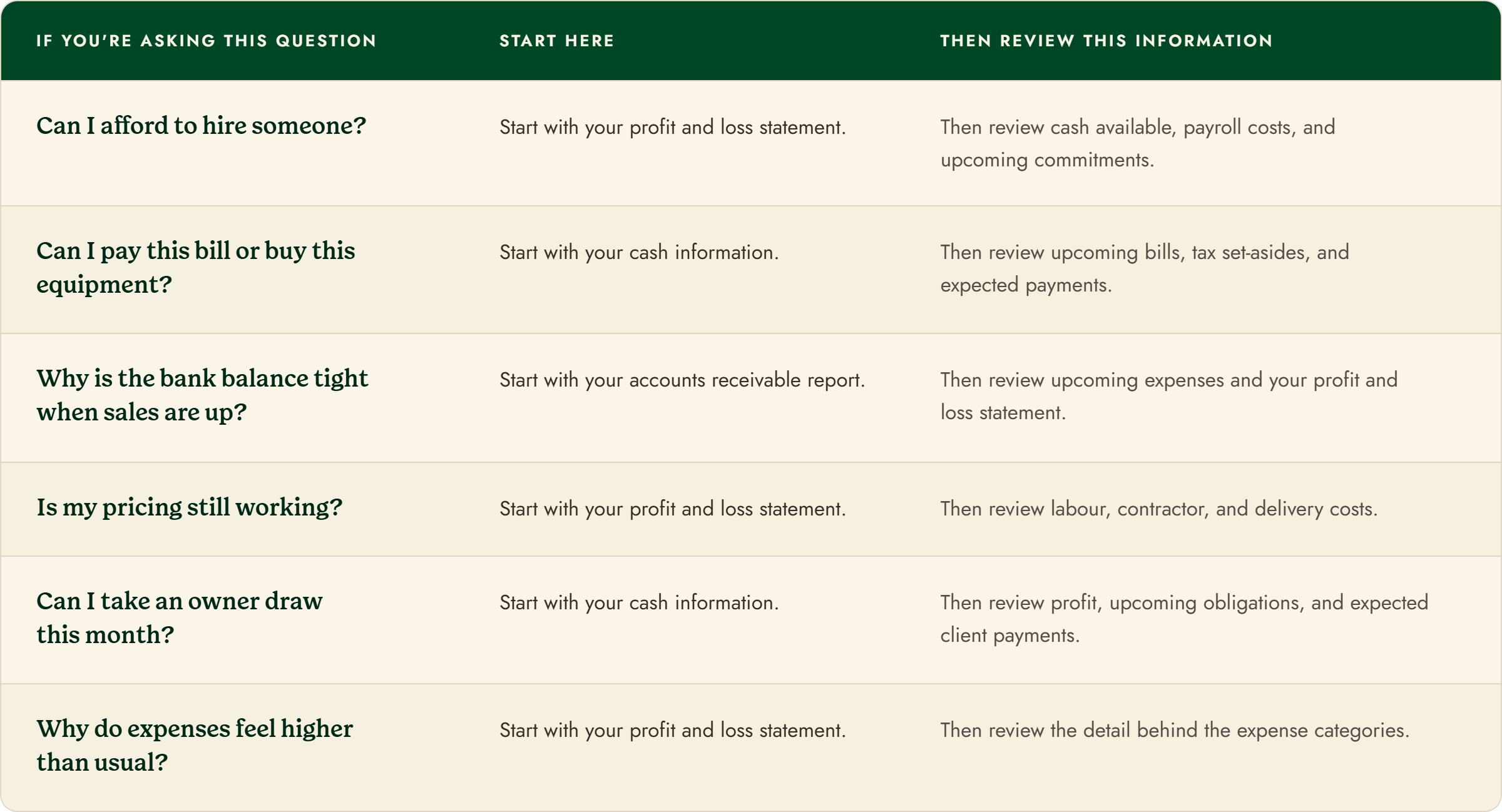
A hiring decision needs a view of profit, cash, and upcoming payroll costs. A purchase decision needs a current cash view and an honest look at what the account must cover first.
What monthly bookkeeping should give you
Monthly bookkeeping should leave you with more than reconciled transactions and a PDF attachment.
You should know that the accounts have been reconciled, unresolved items have been clarified, and the reports reflect reality as closely as possible. You should also receive context around what stood out, what needs attention, and what is not actually a concern.
That may mean flagging receivables that are growing, noticing that contractor costs are affecting profit, or confirming that a higher expense category has a perfectly reasonable explanation. Sometimes the answer is, “Yes, this needs attention.” Sometimes it is, “No, this is normal for this month, and you can take it off your mental list.”
At Brighten, I don’t issue reports while there are unresolved items sitting in the books waiting to be guessed at. Accurate books are the foundation, and plain-language reporting context makes them useful. With that context, you can understand what the numbers are telling you and run the business well.

Ask a better question before opening a report
A bank balance is useful for cash decisions. A profit and loss statement helps you understand profitability and pricing. Accounts receivable tells you how much completed work is still unpaid.
Before opening QuickBooks or refreshing your banking app, pause and ask what decision you’re actually trying to make. Then look at the report built to answer it.
If you’re ready to hand the financial side of the business over completely, ongoing monthly bookkeeping gives you current, accurate books and monthly reporting with plain-language context around what you need to know.